Art Tatum Album Recorded at Jam Session in Harlem
[Go to Page ane]

If Newton was lackluster on the Michigan circulate, he was certainly in superlative form at a jam session at Monroe'southward Uptown House in New York on September 16, 1941. That nighttime, the trumpeter played (at to the lowest degree) two tunes with the legendary pianist Fine art Tatum. Tatum's unrivaled technique and sophisticated harmonic knowledge made him a formidable opponent at later-hours jams, and it wasn't unusual for Tatum to completely obscure his boyfriend musicians (As Roy Eldridge in one case said of the pianist, "If you took a breath, he'd cut y'all!"). Newton not simply holds his own throughout "Oh, Lady Be Good", he matches Tatum's inside jokes and outrageous extended chords on "Sweet Georgia Dark-brown". Newton came prepared—information technology sounds like he inverse from a cup mute to a buzz mute between his beginning ii solos on "Lady"—and he listened carefully to Tatum's lines on "Sweet Georgia" to finer answer with lines of his own. My favorite Newton spot is on "Sweetness Georgia" follows a long Tatum solo where the pianist satirized the bop experiments occurring at Monroe's during the period; Newton enters with a dotted quarter/eighth pattern that seems to mock Tatum's frivolity. Tatum gets him back at the end of the track with a quote from "Buddy Bolden's Blues". Trumpet and piano throw ideas back and forth throughout the 12 minutes of combined track time, but they converge in unexpected means and places. This wonderful recording, caught by Jerry Newman, is one of the treasures of jazz history, and no words can substitute for the joy of hearing this music. (Newman recorded the trumpeter on at to the lowest degree one other occasion. On a track called "Forniculi, Fornicular, Forniculate", Newton plays seven choruses on the changes of "Tea for Two". In that location are numerous stories of Newton stretching out like this at after-hours sessions, only no recordings—including this track—have ever been issued.)
Oh, Lady Exist Expert (Fine art Tatum)
Sweet Georgia Brown (Fine art Tatum)
Newton's romance with Ethel Klein continued throughout this period, and the trumpeter sought gigs in Klein's hometown of Boston. He played at the Savoy club former in 1941 and around that time, he made the acquaintance of three young Jewish jazz fans: Nat Hentoff, George Wein, and Paul Greenberg. All three men wrote loving memorials of Newton in their afterward years, Hentoff in his books "Boston Boy" and "The Jazz Life", Wein in his autobiography "Myself among Others" and Greenberg in an unpublished drove of essays called "Long Days, Curt Nights". Newton became a mentor to each of these young men, offering wisdom on music, politics, athletics and life, also every bit providing each a place to stay whenever they visited New York (although Newton was understandably peeved at Greenberg when the 17-year old showed upward on his doorstep and proclaimed himself Newton's new roommate!). The memories these men shared should be read on their own, only it is worth noting that Newton taught each of them a valuable lesson in the realities of beingness a blackness man in mid-20th century America. We take already noted that Newton became Hentoff's unofficial babysitter when the young human started an interracial relationship. When walking with Greenberg on a Boston street, Newton told the teenager to walk a half a block behind him, and to "run like Hell" if they were jumped. Wein remembers walking downward a Manhattan street and noticing that Newton wanted to get a drink. Wein suggested a bar, simply Newton, knowing the identify'due south white clientele, refused. When Wein asked why, Newton said "George, you've never been black one mean solar day in your life". Over the years, each of these young men played a crucial office in Newton's life; Hentoff and Wein through gigs in Boston, and Greenberg as a swain member of the Communis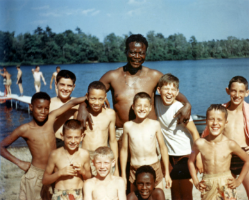 t party.
During the summer of 1941, Newton worked every bit a camp advisor and musician at Camp Unity, a Communist getaway near Poughkeepsie, New York. To fulfill the band obligations, he hired a group which included Sidney Bechet, Everett Barksdale, Arthur Herbert and Willie "the Lion" Smith. The Lion was not very impressed with the temper. In "Music on My Listen", he complains about the food (bad), the housing (a dissimilar tent every dark) and the company ("a nest of commies"). Later on the outset week, he grabbed a railroad train back to New York and sent a new pianist to have his place. Unlike the Lion, Newton seemed to enjoy these vacations, and he worked at several summer camps over the next few years (the photo at correct shows Newton with a grouping of young campers in July 1951; the racial integration is noteworthy for the menstruation). Newton's other activities during this menses included a 1942 concert for Russian War Relief, several appearances on WNEW's jam session series "Hot Jazz Matinee", the showtime of several collaborations with dancer Mura Dehn, a circulate with Fine art Hodes from Nick's in Manhattan, an engagement in Boston from November 1942 through February 1943, and a return to Café Lodge in 1943. During the latter appointment, Newton worked with the great pianist Mary Lou Williams, and it was nether her proper name that Newton finally returned to the recording studios.
The March 12, 1944 session was issued as "Mary Lou and Her Called V", and the band included two of Newton's favorite hornmen, Vic Dickenson and Edmond Hall. In addition to Williams (who besides arranged all of the pieces) the rhythm section featured Al Lucas on bass and Jack "the Comport" Parker on drums. The session was produced past Moe Asch, who shared Newton'due south left-wing politics, and who would tape the trumpeter on two more occasions over the next two years. "Lullaby of the Leaves" opens with a moody introduction with the horns playing background to Williams' tune statement. Hall and Dickenson split up a chorus, merely Newton'south solo is the highlight of the track. The expected motivic development is there, merely it is the way that Newton plumbs the emotional depth of the song with his wounded, soulful tone that makes this solo such an outstanding achievement. Williams must accept loved Newton's way with a ballad, for she created another dull episode for him as the introduction to the boogie "Little Joe from Chicago". Newton makes the best of the opportunity with a lovely loving cup-muted statement. While Newton does not solo in the medium-tempo portion of the side, he can be heard leading the crisp ensemble figures and participating in the band vocal. Williams' combo version of "Curl 'Em" retains many of the riffs from her famous system for the Benny Goodman Orchestra. Williams' eight-to-the-bar pianoforte is the main feature on this side, but while Dickenson and Hall each play fine solos, Newton's chorus is marred by odd note choices and sloppy execution. In the early on Fifties, Asch issued a fifteen-infinitesimal compilation of rehearsals and alternating takes for "Piffling Joe" and "Roll 'Em". There are a few ensemble figures that were cut from the terminal arrangements, a fair amount of churr, several imitation starts, and full-length alternate takes of both titles. The Newton solo on the alternate of "Roll 'Em" is marginally ameliorate than the master, but is withal a poor endeavor for the trumpeter. His lyric lines also seem out of place on the light-hearted session closer, "Satchelmouth Baby". In his earlier recordings, Newton effectively juxtaposed long legato phrases over bouncy rhythms, but on this recording, the effect falls apartment. Was he discouraged with the style the session was proceeding? Was his lip failing him? We may never know, only something was conspicuously going incorrect towards the end of the session.
Lullaby of the Leaves (Mary Lou Williams) FN solo
Picayune Joe from Chicago (Mary Lou Williams) FN intro
The recordings from James P. Johnson's June 12, 1944 session were collected in a concept anthology for Asch titled "New York Jazz". It represented the pianist's interpretation of ragtime and step music as they were played in the 1910s. Newton was the only horn histrion, and the rhythm section included Al Casey (guitar), Pops Foster (bass) and Eddie Dougherty (drums). "Hesitation Blues" represents an early on version of the 12-bar class. Some of the verses sung here past Johnson also appeared on Louis Armstrong'southward "2:xix Blues" and Jelly Curl Morton's "Mamie's Blues" (on his recording, Morton said that the slice was a favorite of Mamie Desdunes, a madam from New Orleans' Storyville commune). Yet, Johnson adds a second 12-bar section in a unlike key and with an alternate chord sequence. Newton plays an elegant introduction and accompanies the Johnson'southward blues choruses, yielding to Casey in the second department. Newton closes the side with an explosion of raw emotion, squeezing and bending notes with neat abandon to create a powerful dejection statement. "Boogie Dream" is a gently flowing limerick based on a pared-down version of the standard left-hand boogie patterns. The second half of the runway includes a series of exchanges between Newton and Johnson. Nigh a infinitesimal before the stop, the piece seems to finish, but it suddenly picks up once again with a variation on the second section. Could this be office of an alternating take dubbed onto the principal? Information technology appears in the same fashion on the master discs, so it's difficult to say. On the final album, Johnson performed Scott Joplin's "Euphonic Sounds" every bit an unaccompanied solo, but a rehearsal take issued subsequently on Folkways is a trio version with Dougherty providing a simple castor-on-snare background, and Newton joining in with a repeated motive on the final strain. Johnson had suffered a stroke a few years earlier, and I suspect that he suggested this version to ensure that his time would remain steady; apparently, Asch or the musicians convinced him that he could play the piece every bit a solo.
Boogie Dream (James P. Johnson) FN/JPJ exchanges and coda
"Four O'Clock Groove" is another relaxed piece, and Newton plays an open solo and an improvised duet with Casey. However, the tone of his horn sounds different, and discographer Bob Weir has suggested that Newton may be playing a flugelhorn on this track. That could be the example (Newton was given a flugelhorn past the family of a friend who died in World War II) just to my ears, the horn sounds more than similar a cornet. Regardless of the musical instrument used, the track gives us the rare opportunity to hear Newton playing in a relaxed, lyric style over several choruses. In addition to his solo, Newton and Casey engage in a delightful improvised dialogue. An alternate take from the session discs omits well-nigh of the Newton/Casey duet, leaving the guitarist to solo on his own, but too includes an boosted Newton chorus at the cease of the track. "The Dream" was written around 1890 by Jesse Pickett, and was a favorite vocal of lesbian prostitutes (i of the vocal'southward many alternating titles is "The Balderdash Dyker's Dream"). It is a slow, seductive tango, and Newton's romantic melody argument is complimented with sparkling figures from Johnson'south keyboard. The rhythm swells in the second one-half of the rails for Johnson's solo and for Newton's superbly-played coda. The session discs include a rehearsal take with solo spots for Newton omitted on the principal, and a slower complete take which heightens the sultry mood merely ran a little too long for a 12" 78. While Newton plays well throughout this session, his best solo comes on the terminal track, "Hot Harlem", where he improvises brilliantly over a finish-fourth dimension groundwork. His horn is tightly muted, and he might be playing through one of his homemade mutes. His audio has more sizzle than with the buzz mute he used earlier, and Newton can be heard singing the pitches equally his plays. Newton removes the mute for the coda, bring this superb session to a close.
Four O'Clock Groove (James P. Johnson) FN solo
Hot Harlem (James P. Johnson) FN solo
In Feb 1945, Newton was featured in a brusk article in the New York Times. Reporter Lucy Greenbaum told of Newton'due south dedication for instruction music to neighborhood children. Newton collected broken instruments, repaired them for the kids and offered gratuitous private lessons. Newton hosted weekly jam sessions at the Pied Piper club (where he also appeared with Johnson) and a portion of the gain went to Greenwich House Music School, where he taught iii days a week. Newton had taught students for some time, every bit evidenced by a commercially unissued disc recorded on July one, 1944. The names of Newton's accompanists are written in pencil on the acetate's characterization with simply first initials and surnames: J. Fales (trombone), J. Moneke (clarinet), H. Zuirk (piano) and H. Practiced (drums). Jazz historian and Newton scholar Dan Morgenstern believes that these players were Newton's students, and he encourages any living survivors to contact the Institute of Jazz Studies to offer more information about the recording. One of the sides is a beautifully understated rendition of "Black and Blue" (a slice otherwise unrecorded by Newton). It is a prime case of Newton'south mature ballad way, and nosotros are happy to offering a stream of this rare and special track.
Black and Blue (FN)
Buck Ram is all-time-known as the producer for the 1950s group, the Platters, but a decade earlier, he was one of the first A&R men for Savoy Records. The "Buck Ram All-Stars" date of September 18, 1944 truly lived up to its proper name, as it featured several of the pinnacle musicians on the New York jazz scene. While all of the musicians were swing players, many of them acted every bit transitional figures in the bebop movement. Newton and Shad Collins shared trumpet duties, with Tyree Glenn on trombone, Earl Bostic, Don Byas and Ernie Caceres on reeds, Red Norvo on vibes, Teddy Wilson on piano, Remo Palmieri on guitar, Slam Stewart on bass and Cozy Cole on drums. Ram was credited as composer for all four of the tunes recorded that day, although the arrangements were apparently uncredited. Newton solos on two tracks. On "Twilight in Teheran" he contributes a brief, but fiery cup-muted solo, placing most of his notes squarely on the trounce. Newton's solo on "Ram Session" uses another mute, possibly a bucket-style mute of his own invention. He follows Bostic, and contrasts the exuberant alto human being's wild phrases with an exquisitely sculpted solo based on classic phrase forms. It'south too bad that Newton didn't have more than room to play, but the arrangements were designed to give solo space to as many of the players as possible. This session features imaginative compositions and arrangements, along with several fine solos, and it should be heard in its entirety, even though Newton's solo opportunities are quite express. Discographies list alternate takes for all of the tracks, but they accept never been issued on commercial discs.
T wilight in Teheran (Buck Ram) FN solo
Ram Session (Buck Ram) Earl Bostic and FN solos
Newton'southward adjacent visit to a recording studio came on October ten, 1944, when he appeared as a member of Hank D'Amico's Sextet. D'Amico was primarily a big band and studio clarinetist, and this session was his debut as a leader. In addition to Newton and D'Amico, the ring includes Don Byas (tenor sax), Dave Rivera (piano), Sid Weiss (bass) and Cozy Cole (drums). The group audio resembles the John Kirby Sextet, and as 1 of the tunes, "Sly Witch from Greenwich" was penned by Newton, I wonder if it was a piece he had written for the Kirby group years earlier. On that track, Newton leads the ensemble's background figures and plays a sorrowful open solo that utilizes behind-the-beat quarter note triplets and expressive bent notes. The session opener was Rivera's "Hank's Pranks", a sprightly ii-beat melody which gives mode to solos in a iv/iv swing groove. D'Amico acquits himself well with a technically adept solo, and Newton contrasts it with a soulful muted turn that takes bang-up liberties with pitch and rhythm. The D'Amico original "Juke Box Judy" finds Newton stretching long ideas over the swift ground trounce, while the slow "Gone at Dawn" is a belatedly Newton dejection masterpiece. His solo is fifty-fifty sparer than on "The Dejection My Baby Gave to Me", and he only gets a solo introduction and a unmarried 12-bar chorus, just he imbues each note with nifty feeling and tenderness.
Sly Piffling Witch from Greenwich (Hank D'Amico) FN solo and out-chorus
Gone at Dawn (Hank D'Amico) FN intro and solo
The terminal four sessions of Newton's career were led by singers of varying quality. Miss Rhapsody was the phase proper noun of Viola Wells, and through her career, she performed jazz, blues and gospel under both names. Information technology is possible that she met Newton at Kelly'due south Stables, one of her favorite places to sing in New York. Newton gets lots of solo space on her November 21, 1944 session, and in that location is a lot of shared warmth in the tones of the vocalist and trumpeter. Newton and Wells' guitarist husband Harold Underhill provide an ongoing obbligato throughout the Benny Carter opus "Blues in My Center". The trumpeter is cached behind the vocal and the tenor of Morris Lound during the opening chorus of "Sugar", but his 8-bar solo is a thing of dazzler, with a full rich open up tone and a floating melodic line. Newton plays a tender introduction on "Downhearted Blues" so performs some other dual obbligato with Lound behind the song (with meliorate balance this time). "Sugariness Man" is the highlight of the session with Wells' earnest vocal inspiring superb solos all effectually, with Newton sounding more inspired than on any other session of this catamenia. The audio stream below collects Newton's solos from iii alternate takes and the master. What a difference a few minutes makes!
Sweet Homo (Miss Rhapsody) composite accept with 4 FN solos and obbligatos
The Albinia Jones session of December 22, 1944 was non issued until the tardily 1970s. One trouble with the engagement was that the singer decided to cover ii of Billie Holiday's virtually famous blues, "Billie'south Blues" and "Fine and Mellow". The comparisons to the original recordings practise non favor Jones. While Jones' pitch and diction are very good, her arsenal of expressive devices was severely express. Newton plays in group obbligatos on "Fine and Mellow" and "What's the Affair with Me", and he plays warm solos on "Billie's Blues" and "Matter", just the whole session feels like an excuse for the musicians to make a little extra holiday coin rather than an effort to make memorable music. A reunion with Big Joe Turner and Pete Johnson from Feb 2, 1945 is considerably improve. Newton's obbligato and solo on the 2-office "S.Yard. Blues" are confident and strong statements. "Johnson and Turner Blues" underwent a few changes between the two takes. The alternating was recorded first, and in it, Turner sang his choruses up front, closing the tape with instrumental solos. Behind Tuner's vocals, Newton, Don Byas and guitarist Leonard Ware took turns playing dual obbligatos with Johnson. When Turner finished, Newton and Johnson played a chorus together. Newton's high-register lines overwhelmed Johnson'due south improvisation, and the thought was scrapped for the master accept. On the master, Turner sings for the first one-half of the tape with the aforementioned obbligato roundelay as before. Then Johnson solos alone, Turner returns with Newton in support, followed by a protracted Newton solo and a Turner reprise on the terminal chorus. Newton tries to cap off the session with a majestic solo on "Sentry that Jive" but a couple of missed high notes ruin the effsect. The Stella Brooks session for Asch was recorded May vii, 1946 (15 months later on the Turner/Johnson appointment!) and it followed on the heels of a Town Hall concert where Newton and Brooks performed. Brooks was originally from San Francisco, only had built a cult following in Greenwich Village. Her sound (only not her pitch and delivery) was comparable to Lee Wiley. The ring on the date is an all-star affair, featuring Newton, trombonist George Brunies, Sidney Bechet, pianist Joe Sullivan, bassist Jack Lesberg and drummer George Wettling. Considering the array of talent, it's too bad that Brooks takes up most of the sides with her barely passable renditions of pop songs and dejection. Newton's all-time moments come on the Harold Arlen standard "As Long equally I Alive" where he plays a finely-synthetic 16-bar variation, an Armstrong-esque blues chorus on "I'm a Little Slice of Leather" and a very brief spot on "Jazz Me Dejection". The residuum of the time, he is buried in the group improvisations, which like everything else in this session, is captured in a muddy, low-fi recording.
Johnson and Turner Blues (Pete Johnson/Big Joe Turner)master take
Equally Long as I Alive (Stella Brooks) FN solo
I'k a Little Piece of Leather (Stella Brooks) FN solo
The Stella Brooks session marked Newton's concluding advent on records. The reasons for his second absence from the studios are a little more than complex. With only one session per year in 1945 and 1946, it's conceivable that Newton was not getting enough pay and exposure from recording, and simply stopped looking for record gigs. However, bebop was also a factor. Since the cease of World War Two, the styles of Dizzy Gillespie, Charlie Parker and Thelonious Monk had become the new linguistic communication of jazz, and any musician who didn't suit to the new music was left in the grit. Newton knew all of these men, simply he was not a bopper and he had no intention of reinventing himself just to attract an audience. In 1946, the choices were Dixieland and bebop, and Newton chose the erstwhile, performing concerts and nightclub engagements with sometime collaborators like Sid Catlett and Edmond Hall. However, in at least one case, Newton took involvement in a young vocaliser. At his altogether political party in 1951, Newton made a private recording with vocalist Barbara Lea (then known by her nascence name, Leacock). The recording has survived but it needs to exist restored. Newton'due south support of Lea's talents can be seen in two pieces of correspondence reproduced here. On but one occasion did Newton express regret nigh his lack of recording opportunities: Wein played Louis Armstrong'southward recording of the pop song called "If". Wein remarked that he idea Armstrong played the melody beautifully; Newton simply shook his caput and said "Homo, if I had the chance, I could do better."
Newton continued to dissever his fourth dimension between Boston and New York. He connected to teach music to children, played benefits for the Communist magazine "New Times", and learned a new skill, painting. In the summer of 1948, he was working as a janitor for an flat building in New York. His apartment in that building caught fire one twenty-four hours, and he lost most of his property, including his clothes, horns, mutes and original paintings. A group of fellow musicians raised enough money to get Newton a adapt and a horn to play a previously scheduled concert. While Newton got back on his anxiety later the fire, his drinking increased as his employment decreased. George Wein did what he could to help his erstwhile friend, offer gigs at his nightclubs "Le Jazz Douxce" [sic] and Storyville, only eventually Newton's alcoholism became too much for Wein to handle, and the two friends parted ways.
In 1954, Newton tried to stage a improvement. A group he fronted successfully auditioned for a spot on the television receiver show, "Arthur Godfrey's Talent Scouts". Notwithstanding, on March 11, earlier the band could appear on air, Newton died of acute gastritis. Idiot box might have been a skillful fit for Newton, as the intensity he projected while playing was very photogenic. With a change in his drinking habits and an apology, he might have been asked to appear at Wein's first Newport Jazz Festival that summer. And—had he lived long enough—he could have been role of the archetype jazz television shows "The Sound of Jazz" (with musical advisor Nat Hentoff) and "Jazz Party" (hosted by longtime New York radio host Art Ford). Sadly, none of those things happened. There was a substantial memorial concert staged in Newton'southward memory, but the trumpeter's scant discography did not pb to posthumous LP reissues. He was soon forgotten, due to his own actions and the short memories of others. All the same, after all of his personal issues have died abroad, the music of Frankie Newton withal speaks to us with a distinctive and soulful voice, iv generations after it was showtime committed to disc.
Deep and abiding thank you to Dan Morgenstern, George Wein, Loren Schoenberg, Jan Evensmo, Tom Buhmann, Scott Wenzel, Tad Hershorn, Joe Peterson, Vincent Pelote, and Bob Weir.
The audio and video recordings embedded in this commodity are presented for educational and illustrative purposes. Jazz History Online neither owns nor controls the rights to these recordings. All rights belong to the original copyright holders.
trowbridgesuman1992.blogspot.com
Source: https://jazzhistoryonline.com/frankie-newton-2b/
0 Response to "Art Tatum Album Recorded at Jam Session in Harlem"
Postar um comentário