Letter From Editor Confirming That a Review Has Been Made
Page Content
Overview of the Review Report Format
The Offset Read-Through
Commencement Read Considerations
Spotting Potential Major Flaws
Concluding the Commencement Reading
Rejection After the First Reading
Before Starting the 2d Read-Through
Doing the 2d Read-Through
The Second Read-Through: Section by Section Guidance
How to Construction Your Report
On Presentation and Mode
Criticisms & Confidential Comments to Editors
The Recommendation
When Recommending Rejection
Boosted Resources
Step by stride guide to reviewing a manuscript
When y'all receive an invitation to peer review, you should be sent a copy of the newspaper's abstract to help you determine whether you wish to do the review. Try to respond to invitations promptly - it will prevent delays. It is also important at this stage to declare any potential Conflict of Interest.
Overview of the Review Report Format
The structure of the review report varies betwixt journals. Some follow an informal structure, while others accept a more formal approach.
"Number your comments!!!" (Jonathon Halbesleben, Editor of Journal of Occupational and Organizational Psychology)
Informal Structure
Many journals don't provide criteria for reviews beyond asking for your 'assay of claim'. In this case, you may wish to familiarize yourself with examples of other reviews done for the journal, which the editor should be able to provide or, as you proceeds experience, rely on your ain evolving manner.
Formal Structure
Other journals require a more formal approach. Sometimes they volition inquire you to address specific questions in your review via a questionnaire. Or they might desire you to rate the manuscript on various attributes using a scorecard. Oftentimes you lot tin can't see these until you log in to submit your review. And so when you lot agree to the piece of work, it's worth checking for any journal-specific guidelines and requirements. If there are formal guidelines, allow them direct the construction of your review.
In Both Cases
Whether specifically required past the reporting format or not, you should wait to compile comments to authors and possibly confidential ones to editors only.
The First Read-Through
Following the invitation to review, when y'all'll have received the commodity abstract, you should already understand the aims, central data and conclusions of the manuscript. If you don't, make a note now that you need to feedback on how to improve those sections.
The offset read-through is a skim-read. It will help you grade an initial impression of the newspaper and get a sense of whether your eventual recommendation volition be to accept or reject the paper.
Get-go Read Considerations
Keep a pen and paper handy when skim-reading.
Try to bear in mind the following questions - they'll assistance you form your overall impression:
- What is the main question addressed by the research? Is it relevant and interesting?
- How original is the topic? What does it add together to the subject area compared with other published material?
- Is the newspaper well written? Is the text articulate and easy to read?
- Are the conclusions consistent with the bear witness and arguments presented? Exercise they address the main question posed?
- If the author is disagreeing significantly with the current academic consensus, do they take a substantial case? If not, what would be required to make their case credible?
- If the paper includes tables or figures, what exercise they add to the newspaper? Do they aid agreement or are they superfluous?
Spotting Potential Major Flaws
While y'all should read the whole newspaper, making the correct option of what to read beginning tin salve time past flagging major bug early on.
Editors say, "Specific recommendations for remedying flaws are VERY welcome."
Examples of possibly major flaws include:
- Drawing a conclusion that is contradicted by the author's ain statistical or qualitative evidence
- The use of a discredited method
- Ignoring a process that is known to have a stiff influence on the expanse nether study
If experimental design features prominently in the paper, beginning bank check that the methodology is sound - if not, this is probable to be a major flaw.
You might examine:
- The sampling in analytical papers
- The sufficient use of command experiments
- The precision of procedure data
- The regularity of sampling in time-dependent studies
- The validity of questions, the use of a detailed methodology and the data analysis being washed systematically (in qualitative enquiry)
- That qualitative research extends beyond the author'south opinions, with sufficient descriptive elements and advisable quotes from interviews or focus groups
Major Flaws in Information
If methodology is less of an event, it'southward often a good idea to look at the data tables, figures or images commencement. Especially in science research, information technology'south all most the information gathered. If there are critical flaws in this, it's very likely the manuscript volition need to exist rejected. Such issues include:
- Insufficient information
- Unclear data tables
- Contradictory information that either are non cocky-consequent or disagree with the conclusions
- Confirmatory information that adds trivial, if anything, to current understanding - unless strong arguments for such repetition are made
If y'all find a major problem, note your reasoning and articulate supporting evidence (including citations).
Final the First Reading
After the initial read and using your notes, including those of any major flaws you found, draft the outset 2 paragraphs of your review - the outset summarizing the inquiry question addressed and the second the contribution of the work. If the journal has a prescribed reporting format, this draft will nonetheless assist you compose your thoughts.
The Kickoff Paragraph
This should land the main question addressed by the research and summarize the goals, approaches, and conclusions of the newspaper. Information technology should:
- Help the editor properly contextualize the inquiry and add together weight to your judgement
- Show the writer what fundamental letters are conveyed to the reader, and then they can exist sure they are achieving what they set out to do
- Focus on successful aspects of the newspaper so the writer gets a sense of what they've done well
The 2nd Paragraph
This should provide a conceptual overview of the contribution of the research. So consider:
- Is the paper's premise interesting and important?
- Are the methods used appropriate?
- Do the data support the conclusions?
After drafting these 2 paragraphs, you should be in a position to decide whether this manuscript is seriously flawed and should be rejected (see the next section). Or whether information technology is publishable in principle and claim a detailed, conscientious read through.
Rejection Afterward the First Reading
Even if you are coming to the opinion that an article has serious flaws, make sure you read the whole paper. This is very of import considering you may find some actually positive aspects that tin can be communicated to the author. This could aid them with future submissions.
A full read-through will also make sure that any initial concerns are indeed correct and fair. After all, you need the context of the whole paper before deciding to refuse. If you lot still intend to recommend rejection, see the department "When recommending rejection."
Before Starting the Second Read-Through
One time the paper has passed your showtime read and you've decided the article is publishable in principle, one purpose of the 2nd, detailed read-through is to help prepare the manuscript for publication. Of course, you may yet decide to reject it following a second reading.
The criterion for credence is whether the manuscript makes a useful contribution to the knowledge base of operations or understanding of the bailiwick matter. It need non exist fully complete enquiry - it may be an interim paper. After all research is an incomplete, on-going project by its nature. The detailed read-through should take no more an 60 minutes for the moderately experienced reviewer.
"Offering articulate suggestions for how the authors tin can address the concerns raised. In other words, if yous're going to raise a problem, provide a solution." (Jonathon Halbesleben, Editor of Journal of Occupational and Organizational Psychology)
Training
To save time and simplify the review:
- Don't rely solely upon inserting comments on the manuscript document - make separate notes
- Effort to group like concerns or praise together
- If using a review program to notation directly onto the manuscript, still try group the concerns and praise in divide notes - it helps later on
- Note line numbers of text upon which your notes are based - this helps you find items again and likewise aids those reading your review
- Keep images, graphs and data tables in clear view - either print them off or have them in view on a second figurer monitor or window
Now that y'all have completed your preparations, yous're ready to spend an hour or then reading carefully through the manuscript.
Doing the 2d Read-Through
Every bit y'all're reading through the manuscript for a second time, y'all'll need to keep in heed the argument's construction, the clarity of the language and content.
With regard to the argument's structure, you should identify:
- Any places where the pregnant is unclear or cryptic
- Any factual errors
- Whatsoever invalid arguments
You may also wish to consider:
- Does the title properly reflect the subject of the newspaper?
- Does the abstract provide an accessible summary of the paper?
- Do the keywords accurately reflect the content?
- Is the newspaper an advisable length?
- Are the key letters curt, authentic and clear?
Non every submission is well written. Part of your part is to make sure that the text's pregnant is articulate.
Editors say, "If a manuscript has many English language linguistic communication and editing bug, delight do not try and prepare it. If it is too bad, annotation that in your review and it should be upward to the authors to have the manuscript edited."
If the article is hard to empathise, you should take rejected it already. However, if the language is poor but you empathise the core bulletin, run across if you can suggest improvements to fix the problem:
- Are there certain aspects that could be communicated better, such as parts of the discussion?
- Should the authors consider resubmitting to the same journal later language improvements?
- Would you consider looking at the newspaper again once these bug are dealt with?
On Grammar and Punctuation
Your primary role is judging the research content. Don't spend time polishing grammar or spelling. Editors will make sure that the text is at a loftier standard before publication. Nevertheless, if you spot grammatical errors that affect clarity of meaning, so information technology'southward important to highlight these. Expect to suggest such amendments - it's rare for a manuscript to laissez passer review with no corrections.
A 2010 written report of nursing journals found that 79% of recommendations past reviewers were influenced past grammar and writing fashion (Shattel, et al., 2010).
The 2d Read-Through: Section by Department Guidance
1. The Introduction
A well-written introduction:
- Sets out the argument
- Summarizes recent enquiry related to the topic
- Highlights gaps in electric current understanding or conflicts in electric current knowledge
- Establishes the originality of the research aims by demonstrating the need for investigations in the topic expanse
- Gives a clear idea of the target readership, why the enquiry was carried out and the novelty and topicality of the manuscript
Originality and Topicality
Originality and topicality tin only be established in the light of contempo authoritative inquiry. For example, it'due south incommunicable to contend that there is a conflict in electric current agreement by referencing articles that are 10 years old.
Authors may make the case that a topic hasn't been investigated in several years and that new inquiry is required. This point is only valid if researchers can point to recent developments in information gathering techniques or to research in indirectly related fields that suggest the topic needs revisiting. Clearly, authors can only practise this by referencing recent literature. Obviously, where older research is seminal or where aspects of the methodology rely upon information technology, then it is perfectly appropriate for authors to cite some older papers.
Editors say, "Is the study providing new information; is it novel or but confirmatory of well-known outcomes?"
Aims
Information technology's common for the introduction to end by stating the research aims. By this bespeak you lot should already have a good impression of them - if the explicit aims come as a surprise, so the introduction needs improvement.
two. Materials and Methods
Bookish research should be replicable, repeatable and robust - and follow all-time practice.
Replicable Enquiry
This makes sufficient utilize of:
- Control experiments
- Repeated analyses
- Repeated experiments
- Sampling
These are used to brand sure observed trends are not due to chance and that the same experiment could exist repeated past other researchers - and issue in the same outcome. Statistical analyses will not be sound if methods are not replicable. Where research is not replicable, the paper should be recommended for rejection.
Repeatable Methods
These give plenty particular so that other researchers are able to carry out the same research. For case, equipment used or sampling methods should all exist described in detail then that others could follow the same steps. Where methods are not detailed enough, it'due south usual to ask for the methods section to be revised.
Robust Research
This has enough information points to make sure the data are reliable. If there are insufficient data, information technology might be appropriate to recommend revision. You should too consider whether there is any in-built bias not nullified by the control experiments.
Best Do
During these checks yous should keep in mind best practice:
- Standard guidelines were followed (east.one thousand. the CONSORT Statement for reporting randomized trials)
- The health and safe of all participants in the study was not compromised
- Ethical standards were maintained
If the research fails to reach relevant all-time practice standards, it's usual to recommend rejection. What's more, you lot don't then demand to read any farther.
3. Results and Discussion
This department should tell a coherent story - What happened? What was discovered or confirmed?
Certain patterns of good reporting demand to be followed past the author:
- They should kickoff by describing in simple terms what the data show
- They should make reference to statistical analyses, such as significance or goodness of fit
- One time described, they should evaluate the trends observed and explain the significance of the results to wider understanding. This can only be done by referencing published research
- The event should be a critical analysis of the data collected
Discussion should ever, at some point, gather all the information together into a single whole. Authors should describe and hash out the overall story formed. If at that place are gaps or inconsistencies in the story, they should address these and advise ways future research might ostend the findings or accept the inquiry forrad.
4. Conclusions
This department is commonly no more than a few paragraphs and may exist presented as function of the results and discussion, or in a separate department. The conclusions should reflect upon the aims - whether they were achieved or not - and, simply like the aims, should not be surprising. If the conclusions are not evidence-based, it'due south appropriate to ask for them to exist re-written.
v. Data Gathered: Images, Graphs and Data Tables
If you detect yourself looking at a slice of information from which you cannot discern a story, then you should enquire for improvements in presentation. This could be an upshot with titles, labels, statistical annotation or image quality.
Where data is articulate, you should check that:
- The results seem plausible, in example there is an mistake in data gathering
- The trends y'all tin meet support the paper'south discussion and conclusions
- There are sufficient data. For case, in studies carried out over time are there sufficient data points to back up the trends described by the writer?
You should too check whether images accept been edited or manipulated to emphasize the story they tell. This may be advisable but only if authors report on how the prototype has been edited (e.1000. by highlighting certain parts of an image). Where yous feel that an paradigm has been edited or manipulated without explanation, you should highlight this in a confidential comment to the editor in your study.
6. Listing of References
Y'all will demand to check referencing for accurateness, adequacy and residual.
Accurateness
Where a cited article is central to the author's argument, you should bank check the accuracy and format of the reference - and bear in mind dissimilar subject areas may use citations differently. Otherwise, it's the editor'south role to exhaustively check the reference section for accurateness and format.
Capability
You should consider if the referencing is adequate:
- Are of import parts of the argument poorly supported?
- Are there published studies that prove similar or dissimilar trends that should exist discussed?
- If a manuscript merely uses half the citations typical in its field, this may be an indicator that referencing should be improved - but don't be guided solely by quantity
- References should be relevant, contempo and readily retrievable
Balance
Check for a well-balanced list of references that is:
- Helpful to the reader
- Fair to competing authors
- Not over-reliant on self-commendation
- Gives due recognition to the initial discoveries and related piece of work that led to the work under assessment
You should be able to evaluate whether the article meets the criteria for balanced referencing without looking up every reference.
seven. Plagiarism
By now you lot will accept a deep understanding of the paper'south content - and you may have some concerns nearly plagiarism.
Identified Concern
If yous find - or already knew of - a very like paper, this may be because the author disregarded it in their own literature search. Or information technology may exist because information technology is very recent or published in a periodical slightly outside their usual field.
You may feel yous can advise the author how to emphasize the novel aspects of their own study, so as to improve differentiate it from similar research. If and so, you may ask the author to hash out their aims and results, or modify their conclusions, in low-cal of the like article. Of grade, the research similarities may exist and then great that they render the piece of work unoriginal and you lot have no option but to recommend rejection.
"It'due south very helpful when a reviewer can point out recent similar publications on the same topic by other groups, or that the authors take already published some data elsewhere." (Editor feedback)
Suspected Business
If y'all suspect plagiarism, including self-plagiarism, but cannot call back or locate exactly what is beingness plagiarized, notify the editor of your suspicion and inquire for guidance.
Well-nigh editors take access to software that can check for plagiarism.
Editors are not out to police every paper, but when plagiarism is discovered during peer review it tin exist properly addressed alee of publication. If plagiarism is discovered only after publication, the consequences are worse for both authors and readers, because a retraction may be necessary.
For detailed guidelines see COPE's Ethical guidelines for reviewers and Wiley's Best Practice Guidelines on Publishing Ethics.
viii. Search Engine Optimization (SEO)
After the detailed read-through, you lot will be in a position to advise whether the title, abstract and key words are optimized for search purposes. In club to be effective, good SEO terms will reverberate the aims of the inquiry.
A clear title and abstract will better the paper's search engine rankings and will influence whether the user finds and and so decides to navigate to the main article. The title should comprise the relevant SEO terms early on. This has a major effect on the affect of a paper, since information technology helps it appear in search results. A poor abstract can then lose the reader's interest and undo the do good of an effective title - whilst the paper's abstract may appear in search results, the potential reader may get no farther.
So ask yourself, while the abstract may have seemed adequate during earlier checks, does it:
- Do justice to the manuscript in this context?
- Highlight important findings sufficiently?
- Present the near interesting data?
Editors say, "Does the Abstract highlight the important findings of the written report?"
How to Construction Your Report
If there is a formal written report format, retrieve to follow information technology. This will often comprise a range of questions followed by comment sections. Try to answer all the questions. They are there because the editor felt that they are important. If you're following an informal report format you could structure your written report in three sections: summary, major problems, small issues.
Summary
- Give positive feedback first. Authors are more likely to read your review if y'all practise and so. Simply don't overdo it if yous will be recommending rejection
- Briefly summarize what the paper is nearly and what the findings are
- Try to put the findings of the newspaper into the context of the existing literature and electric current knowledge
- Indicate the significance of the piece of work and if it is novel or mainly confirmatory
- Point the work's strengths, its quality and abyss
- State any major flaws or weaknesses and annotation any special considerations. For example, if previously held theories are existence overlooked
Major Problems
- Are there whatever major flaws? Land what they are and what the severity of their touch on is on the paper
- Has similar piece of work already been published without the authors acknowledging this?
- Are the authors presenting findings that challenge current thinking? Is the show they nowadays strong enough to show their case? Have they cited all the relevant work that would contradict their thinking and addressed it accordingly?
- If major revisions are required, endeavour to indicate conspicuously what they are
- Are there any major presentational issues? Are figures & tables, language and manuscript structure all clear enough for you to accurately assess the work?
- Are at that place whatever ethical issues? If you lot are unsure information technology may be amend to disclose these in the confidential comments department
Minor Issues
- Are at that place places where significant is ambiguous? How can this be corrected?
- Are the right references cited? If not, which should exist cited instead/too? Are citations excessive, limited, or biased?
- Are in that location any factual, numerical or unit errors? If and then, what are they?
- Are all tables and figures advisable, sufficient, and correctly labelled? If not, say which are non
On Presentation and Style
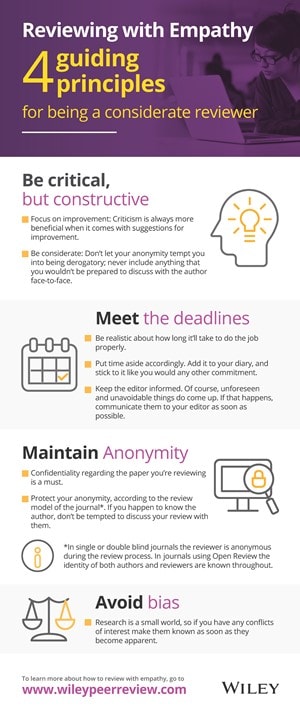
Your review should ultimately assist the writer meliorate their article. Then be polite, honest and clear. Y'all should also try to be objective and effective, non subjective and destructive.
You should also:
- Write clearly then yous can be understood by people whose first language is not English language
- Avoid complex or unusual words, especially ones that would fifty-fifty confuse native speakers
- Number your points and refer to page and line numbers in the manuscript when making specific comments
- If y'all accept been asked to simply annotate on specific parts or aspects of the manuscript, y'all should indicate clearly which these are
- Treat the writer's work the way you would like your ain to be treated
Criticisms & Confidential Comments to Editors
Most journals requite reviewers the option to provide some confidential comments to editors. Often this is where editors will want reviewers to country their recommendation - see the next section - but otherwise this area is best reserved for communicating malpractice such as suspected plagiarism, fraud, unattributed work, unethical procedures, indistinguishable publication, bias or other conflicts of interest.
However, this doesn't give reviewers permission to 'backstab' the author. Authors can't see this feedback and are unable to give their side of the story unless the editor asks them to. So in the spirit of fairness, write comments to editors equally though authors might read them likewise.
The Recommendation
Reviewers should check the preferences of private journals as to where they desire review decisions to be stated. In particular, bear in mind that some journals will not want the recommendation included in whatsoever comments to authors, every bit this can cause editors difficulty later - see Section 11 for more advice virtually working with editors.
You will normally be asked to betoken your recommendation (e.g. accept, reject, revise and resubmit, etc.) from a fixed-choice list and so to enter your comments into a separate text box.
Recommending Acceptance
If you're recommending credence, give details outlining why, and if there are any areas that could be improved. Don't just give a short, cursory remark such as 'great, accept'. See Improving the Manuscript
Recommending Revision
Where improvements are needed, a recommendation for major or small-scale revision is typical. Y'all may also cull to land whether you opt in or out of the post-revision review also. If recommending revision, state specific changes you experience need to be made. The author can then reply to each signal in plow.
Some journals offering the option to recommend rejection with the possibility of resubmission – this is well-nigh relevant where substantial, major revision is necessary.
What can reviewers practise to help? "Exist clear in their comments to the writer (or editor) which points are absolutely disquisitional if the newspaper is given an opportunity for revision." (Jonathon Halbesleben, Editor of Periodical of Occupational and Organizational Psychology)
Recommending Rejection
If recommending rejection or major revision, state this clearly in your review (and encounter the next section, 'When recommending rejection').
When Recommending Rejection
Where manuscripts take serious flaws yous should non spend any time polishing the review you've drafted or give detailed advice on presentation.
Editors say, "If a reviewer suggests a rejection, but her/his comments are not detailed or helpful, it does not help the editor in making a decision."
In your recommendations for the author, you should:
- Give effective feedback describing ways that they could ameliorate the research
- Keep the focus on the enquiry and not the author. This is an extremely of import part of your job equally a reviewer
- Avoid making critical confidential comments to the editor while beingness polite and encouraging to the author - the latter may non understand why their manuscript has been rejected. Also, they won't become feedback on how to improve their enquiry and information technology could trigger an appeal
Recollect to requite constructive criticism fifty-fifty if recommending rejection. This helps developing researchers better their work and explains to the editor why you lot felt the manuscript should not be published.
"When the comments seem really positive, just the recommendation is rejection…it puts the editor in a tough position of having to reject a newspaper when the comments get in audio like a swell paper." (Jonathon Halbesleben, Editor of Journal of Occupational and Organizational Psychology)
Boosted Resources
Visit our Wiley Author Learning and Training Channel for skillful communication on peer review.
Spotter the video, Ethical considerations of Peer Review
trowbridgesuman1992.blogspot.com
Source: https://authorservices.wiley.com/Reviewers/journal-reviewers/how-to-perform-a-peer-review/step-by-step-guide-to-reviewing-a-manuscript.html
0 Response to "Letter From Editor Confirming That a Review Has Been Made"
Postar um comentário